The Ascendant is not who you are. It is where you stand.
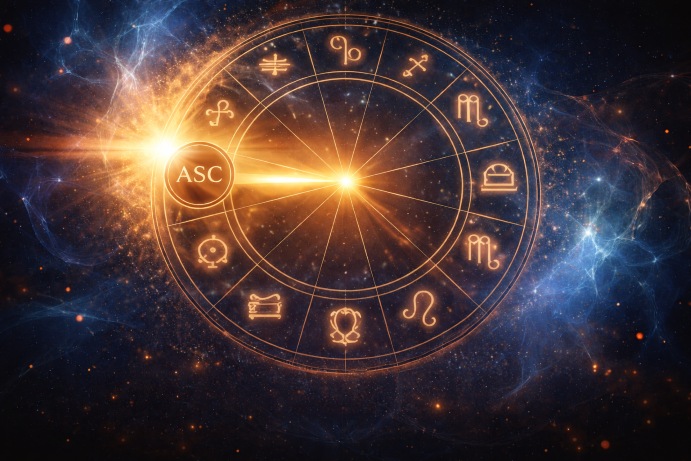
Astrology does not begin with planets. It begins with a point of orientation.
The Ascendant is that reference point of orientation. It is the exact point on the zodiac rising on the eastern horizon at the moment of birth. Astronomically, it is spatial. Astrologically, it is orientational.
The Ascendant is not a personality trait, not a mask, and not a descriptive label. It is a moment—the precise interface where individual consciousness meets time and space. It marks how life is entered before reflection, choice, or strategy appear. Everything else in the chart unfolds from this initial posture.
What the Ascendant Actually Is
The Ascendant represents:
- the starting condition of experience,
- the default orientation toward life,
- the instinctive way reality is first met.
It is not identity (Sun). It is not perception (Moon). It is the point of contact between consciousness and time–space.
Astrology requires such a point because experience cannot exist without orientation. Something must define where the experiencer stands when life starts unfolding. The Ascendant is that anchor. All measurements—houses, angles, planetary placements—depend on it.
Without the Ascendant, a chart has information but no perspective.
What Are Houses as a Sequence of Life Experience, and How Does the Ascendant Shape Them?
Houses are not “areas of life.” They are stages of lived experience.
Experience unfolds sequentially, not modularly. One cannot stabilize before existing, cannot transform before encountering resistance, cannot withdraw before participating. The houses encode this sequence.
- 1st house (Pisces) : Life begins through permeability, sensitivity, absorption
- 2nd house (Aries) : Stability is acquired through assertion and effort, not inheritance or comfort.
- 3rd house (Taurus) : Skill develops through persistence and repetition, not speed.
- 4th house (Gemini) : Emotional security comes through dialogue and understanding, not rootedness.
- 5th house (Cancer) : Expression is protective and emotionally invested.
The same house sequence exists for everyone. What changes is how each stage feels and functions, because the Ascendant fixes the signs occupying those houses.
Thus, houses cannot be read independently. Their meaning is conditioned by the Ascendant that anchors them.
Why Does a Beginning (Ascendant) Necessarily Create a Trajectory?
Because experience is path-dependent. Any system that unfolds over time carries the bias of its initial condition. This is not astrology; it is systems logic.
Once consciousness enters life from a particular orientation, every subsequent experience is filtered through it. Growth does not erase the starting posture; it elaborates upon it. To demonstrate, compare the same house across different Ascendants.
Take the 8th house (transformation):
- Pisces Ascendant → 8th house is Libra
Transformation occurs through relational imbalance, negotiation, loss of harmony. - Aries Ascendant → 8th house is Scorpio
Transformation occurs through confrontation, crisis, intensity, control collapse.
Same house. Same life phase. Radically different trajectory.
The difference is not fate. It is the consequence of where life began. The Ascendant does not decide what happens. It decides how change is encountered.
How Does the Ascendant Continue to Operate Throughout Life?
The Ascendant is not outgrown. Personality evolves. Skills mature. Beliefs change. Orientation persists.
Under stress, uncertainty, initiation, or crisis, individuals revert to their Ascendant posture instinctively. This is because the Ascendant is not learned behavior; it is the default stance of consciousness.
Growth modifies expression, not orientation. A Pisces Ascendant may learn boundaries, discipline, and clarity—but the world is still first encountered through sensitivity. An Aries Ascendant may learn patience and restraint—but life is still entered through assertion.
This is why:
- success does not eliminate Ascendant patterns,
- failure does not rewrite them,
- transformation does not replace them.
The Ascendant is where life keeps restarting from.
What Breaks If the Ascendant Is Treated as only Personality?
Everything structural breaks. If the Ascendant is reduced to “outer personality”:
- houses become isolated topics,
- life stages lose sequence,
- transformation becomes random,
- astrology turns descriptive instead of causal.
More importantly, astrology loses its experiential spine.
Charts become lists of traits rather than maps of process. Interpretation becomes interchangeable. Two lives with different orientations start looking the same on paper.
Astrology only works when the Ascendant is treated as orientation, not description.
Closing Integration
The Ascendant is not who you are. It is where you stand. From that position:
- life unfolds in sequence,
- experience becomes path-dependent,
- growth modifies but does not replace orientation.
Astrology begins with the Ascendant because experience itself must begin somewhere. Everything else derives meaning only in relation to this starting point.
Everything else in the chart is secondary to that fact.