Mars and Saturn: Force vs Structure, Speed vs Endurance
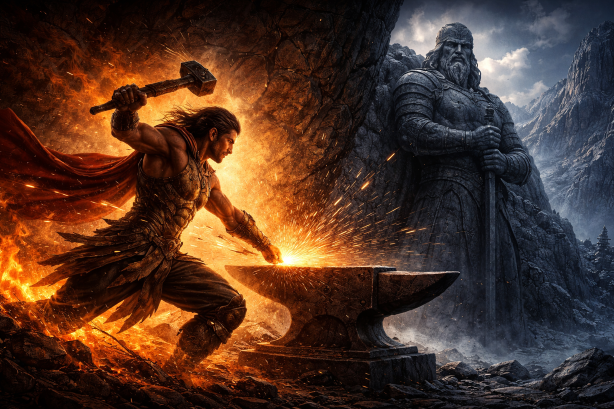
Mars and Saturn form one of the most misunderstood axes in astrology. They are often labeled as enemies, malefics, or sources of struggle. This interpretation misses the point entirely.
Mars and Saturn are not moral opposites. They are functional complements operating on different timelines.
Understanding this axis explains:
- why Mars exalts in Saturn’s sign,
- why Saturn debilitates in Mars’ sign,
- why their conjunction feels heavy and difficult,
- and why true mastery in life requires both.
1. What Does Mars Fundamentally Represent?
Mars represents initiation of force. It is the planetary function that:
- acts before certainty,
- asserts will directly,
- breaks inertia,
- prioritizes immediacy over consequence.
Mars answers one question only: “Should something be done now?”
This is why Mars governs action, confrontation, courage, and survival. Anger is not Mars’s nature; it appears when Mars is obstructed.
2. What Does Saturn Fundamentally Represent?
Saturn represents structure sustained through time. It is the planetary function that:
- delays action until it is viable,
- enforces limits,
- accounts for consequences,
- preserves systems beyond individual effort.
Saturn answers a different question: “Can this action last?”
Saturn is not punishment. It is time demanding order.
3. Why Are Mars and Saturn Experienced as Opposites?
Because they operate on opposite temporal logics.
- Mars acts in the present.
- Saturn evaluates across duration.
Mars breaks inertia. Saturn prevents waste.
Mars without Saturn burns out. Saturn without Mars never begins.
This tension is structural, not hostile.
4. What Does Exaltation Mean for Mars?
For Mars, exaltation does not mean aggression or dominance. It means force refined into authority.
Exalted Mars does not act impulsively, does not waste energy and chooses battles strategically.
Mars reaches its highest expression when:
- action is restrained without suppression,
- effort is sustained rather than explosive.
Mars does not exalt where it is free. It exalts where it is disciplined.
5. Why Does Mars Exalt in Capricorn, and Why Near 28°?
Capricorn is Saturn’s sign. It represents hierarchy, accountability, delayed reward and endurance. Capricorn stops Mars from being reckless.
Early Capricorn feels restrictive to Mars. Action is frustrated by rules. Late Capricorn—around 28°—represents mastery of structure.
At this stage:
- discipline is internalized,
- patience no longer feels like suppression,
- restraint becomes a weapon.
Mars here does not rush. It waits until resistance collapses. That is why Mars exalts at late Capricorn.
6. What Does Debilitation Mean for Saturn?
For Saturn, debilitation does not mean weakness.
It means loss of relevance.
Saturn’s tools—delay, planning, sequencing—still exist, but the environment no longer rewards them.
Debilitated Saturn is not broken. It is ignored.
7. Why Does Saturn Debilitate in Aries, and Why at 20° Aries?
Saturn debilitates at 20° Aries. This degree represents the peak expression of Saturn's nature.
Aries values speed, initiative, risk and action as identity.
By mid-Aries momentum is already in motion, hesitation is punished and delay equals failure.
At 20° Aries:
- action cannot be paused,
- planning feels obstructive,
- restraint feels irrelevant.
Saturn still attempts to slow down and impose order, but the environment does not respond.
That is Saturn’s debilitation: its function loses authority in a world that demands immediate action.
8. Are Mars and Saturn Enemies?
No.
“Enemy” in classical texts refers to functional incompatibility, not hostility.
Mars disrupts systems Saturn wants to preserve. Saturn delays forces Mars wants to unleash.
This is a conflict of timing, not intent.
Reading planets as enemies moralizes astrology. Reading them as opposites preserves its logic.
9. How Do Mars and Saturn Cooperate in Real Life When Aligned Well?
When Mars and Saturn Are Conjunct in the Same Sign
A conjunction forces both planets to operate in the same environment at the same time.
Mars urges action. Saturn urges delay.
The lived experience often includes:
- hesitation before acting,
- repeated review of decisions,
- effort that feels heavy or constrained,
- bursts of action followed by pauses.
Psychologically, this often feels like “I want to move, but something keeps stopping me.” This is not dysfunction. It is internal sequencing pressure.
Over time, this produces disciplined execution, resistance to impulsive mistakes, and endurance under stress.
These natives often excel in fields where:
- action must obey rules,
- errors are costly,
- force must be controlled.
Examples include engineering, surgery, military strategy, law enforcement, disciplined sports, and large-scale project execution.
When Mars and Saturn Oppose Each Other (Mutual Aspect)
Mutual Aspect externalizes the tension.
Mars experiences Saturn's aspect as authority and resistance. Saturn experiences Mars' aspect as pressure and urgency.
This produces:
- high awareness of consequences,
- visible struggle between speed and restraint,
- capacity for leadership under pressure.
Such individuals often become crisis managers or leaders who act only when action is unavoidable—but act decisively.
10. Why Mastery Requires Integration of Mars and Saturn
Mars–Saturn alignment does not give comfort. It gives control under pressure.
True mastery occurs when:
- Saturn decides when action is allowed,
- Mars executes fully once permission is given.
In practice, it gives long preparation phase, followed by decisive and sustained action.
These people act later than others, but rarely need to act twice.