Yoni in Astrology: The Instinct Layer of the Mind
Astrology often explains what a person seeks and why they are driven toward certain experiences. Yet it frequently fails to explain something more immediate and more confusing:
Why do people behave the way they do, even when their intent is clear to themselves?
The concept of Yoni exists precisely to answer this.
Yoni is not a secondary add-on, not a compatibility gimmick, and not a moral classifier. It is the instinctive behavioral grammar of a Nakshatra.
1. What Is Yoni in the Nakshatra System, Fundamentally?
In Vedic astrology, Yoni is the instinctual and relational nature of a nakshatra — it describes how a person bonds, desires, approaches intimacy, trust, conflict, and compatibility at a primal, unconscious level. It is not about morality; it is about the animal-level pattern of approach, attraction, defense, and interaction that operates beneath personality and choice. Yoni represents the instinctive mode of expression of a Nakshatra.
It also describes how an individual approaches, retreats, guards, bonds and reacts under closeness or threat, before conscious thought intervenes.
Yoni operates at a pre-rational level. It is not chosen. It is enacted.
If Nakshatra defines direction, Yoni defines movement style.
2. Why Did the Nakshatra System Require Yoni in Addition to Nakshatra Itself?
The Nakshatra system did not introduce Yoni to explain differences between people with the same Nakshatra. It introduced Yoni to complete the definition of a Nakshatra itself.
A Nakshatra describes:
- the intent of consciousness,
- the kind of fulfillment it seeks,
- the psychological problem it is oriented toward solving.
But intent alone is incomplete. Every intent must have a mode of approach, a reflexive behavior pattern and an instinctive way of engaging the world.
Yoni provides this.
Because Nakshatra and Yoni are fixed together, the why and the how are inseparable, motivation and instinct form a single psychological unit.
Two people with the same Nakshatra:
- seek the same kind of fulfillment (Nakshatra),
- and move toward it through the same instinctive behavior (Yoni),
even though maturity, planetary placements, and awareness may differ.
Yoni does not introduce variability. It introduces mechanical completeness.
Without Yoni:
- Nakshatra would describe purpose without behavior,
- astrology would explain desire without showing how it manifests.
Yoni is the behavioral grammar of Nakshatra.
3. How Is Yoni Different from Nakshatra Motivation in Lived Experience?
The difference is experiential and unavoidable.
- Nakshatra answers: Why am I drawn toward this?
- Yoni answers: How do I instinctively move when I am drawn?
Nakshatra operates at a semi-conscious level. You can reflect on it, articulate it, and understand it.
This is why people often say:
- “I knew what I wanted, but I don’t know why I reacted that way.”
- “That wasn’t my intention, but it still happened.”
Yoni operates before reflection. You notice it after it has already acted.
The intention was Nakshatra. The reaction was Yoni.
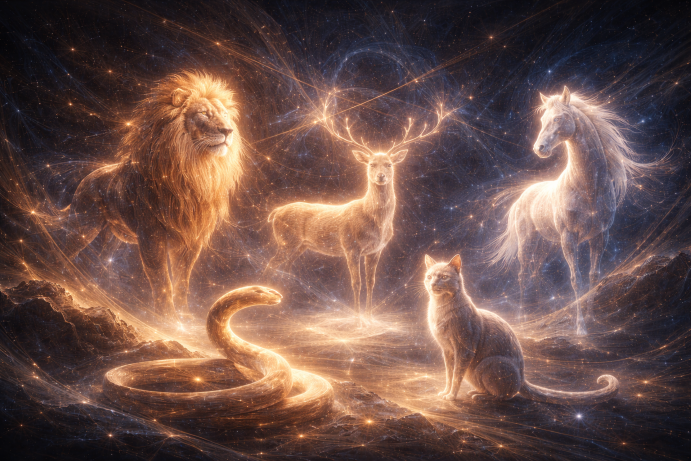
4. Why Are Yonis Represented Through Animal Archetypes?
Because animals act without narrative.
They do not justify, rationalize, or moralize. They respond directly to proximity, threat, opportunity, and safety.
This is exactly how instinct operates in humans.
Animal archetypes remove:
- social conditioning,
- moral interpretation,
- intellectual excuses.
Animals are not metaphors here. They are models of instinctual mechanics. They show behavior in its raw, reflexive form.
5. When Does Yoni Become Most Visible in Real Life?
Yoni becomes visible when conscious control weakens.
This happens during:
- emotional vulnerability,
- intimacy,
- attraction or repulsion,
- stress or fear,
- exhaustion.
In these moments thinking slows, self-image drops and instinct takes the lead. This is why Yoni is most evident in close relationships, private behavior and moments people later struggle to explain.
Yoni does not appear when we are composed. It appears when we are exposed.
6. How Does Yoni Shape Attraction, Repulsion, and Relational Friction?
Attraction is instinctive before it is logical.
Two people may align intellectually yet feel discomfort because their instinctive modes of engagement clash.
Conversely, people may differ in worldview yet feel drawn together due to instinctive resonance.
Yoni explains:
- chemistry without explanation,
- friction without hostility,
- comfort without agreement.
Instinct moves faster than thought. Yoni acts before compatibility is evaluated.
7. Why Is Yoni Most Accurately Read Through the Moon’s Nakshatra?
Because the Moon governs the instinctive mind, emotional reflex and subconscious response.
The Moon is where experience is felt before it is processed.
Planetary Nakshatras show instinct in specific domains. The Moon’s Nakshatra shows how instinct operates globally.
That is why Yoni tied to the Moon’s Nakshatra shapes habitual responses, governs relational reflexes and dominates emotional behavior.
8. How Should Yoni Be Used Correctly for Self-Understanding?
Yoni must be observed, not judged.
Correct use involves noticing patterns, identifying triggers, and recognizing reflex without self-condemnation. Yoni is not meant to be suppressed. It is meant to be seen clearly.
Awareness introduces a pause. That pause creates choice.
Yoni explains behavior. It does not excuse it.
Final Compression
- Nakshatra → why a desire exists
- Yoni → how that desire moves instinctively
- Nakshatra sets direction
- Yoni sets behavior
Understanding Yoni does not make you instinct-driven. It makes instinct visible.
And what becomes visible can be integrated.