Ashlesha Nakshatra: Meaning, Nature, and Evolutionary Role
1. What a Nakshatra Really Is
A nakshatra is not a personality trait but a deep psychological conditioning field. While planets show what is acting and zodiac signs show how it expresses, nakshatras reveal why reactions arise instinctively and emotionally. They operate below conscious thought, shaping reflexes, attachment patterns, and inner responses before choice or reasoning appears. This is why nakshatras feel personal — they show how experience is processed at the deepest level of the mind.
This nakshatra shows how consciousness binds in order to feel safe.
If Punarvasu restores and Pushya stabilizes, Ashlesha tightens. Ashlesha appears when structure alone is not enough — control is added.
Here nourishment turns inward and protection becomes psychological. Ashlesha represents binding intelligence.
2. Core Nature of Ashlesha (Essence)
Ashlesha’s core drive is to hold, grip, and contain.
It represents the instinct: “If I bind this, I can prevent loss.”
Ashlesha does not act openly. Ashlesha influences silently, working through emotional leverage and strategic containment. Ashlesha survives by not letting go.
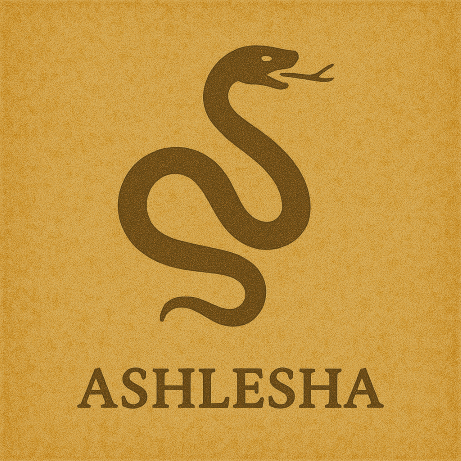
3. Symbol and Its Psychological Meaning — The Serpent
The serpent does not attack immediately. It coils, waits, and constricts.
Psychologically, the symbol represents control through proximity, latent power, and influence without exposure.
Ashlesha wraps rather than overpowers. This makes Ashlesha deeply perceptive — and potentially dangerous when unconscious.
4. Ruling Deity — Sarpa
Sarpa represents primal instinct and latent threat. Sarpa energy governs survival reflexes, boundary enforcement and defensive intelligence
Under Ashlesha, Sarpa operates as psychological vigilance, sensitivity to betrayal and readiness to strike if threatened. Ashlesha trusts instinct over openness.
5. Planetary Ruler — Mercury
Mercury gives Ashlesha sharp intelligence, strategic thinking and control - verbal and mental.
Mercury allows Ashlesha to read patterns in people, anticipate reactions and influence outcomes quietly. This is why Ashlesha can heal or poison — depending on awareness. Ashlesha does not use force. It uses mind. Control here is mental, not physical.
6. How Ashlesha Expresses When Strong
A mature Ashlesha produces psychological insight, protective intelligence and strategic restraint.
Such individuals perceive hidden motives, guard what is valuable and intervene quietly before damage occurs. They often excel in psychology, healing, strategy, intelligence, or crisis containment — roles requiring subtle control rather than force.
7. How Ashlesha Distorts When Unconscious
Without awareness, Ashlesha becomes manipulative, paranoid and fear-driven. Common distortions:
- Emotional control
- Using insight to dominate
- Guilt-based influence
- Distrust of vulnerability
This is control born from fear, not wisdom.
8. Relationship with the Moon
Moon in Ashlesha creates a mind that feels safe through control, bonds intensely but defensively and struggles with trust. Emotionally, openness feels dangerous.
Such individuals test loyalty repeatedly, hold emotions tightly and release slowly, if at all.
Security comes from holding, not sharing.
9. Evolutionary Lesson of Ashlesha
Ashlesha must learn that Control does not create safety. Awareness does..
The lesson is to release without collapse, to trust perception without manipulation and to transform grip into understanding. Ashlesha matures when it learns: “I can perceive deeply without binding.”
10. Summary
Ashlesha is the intelligence of containment. It protects by binding, sensing, and controlling. When unconscious, it entraps and manipulates. When mature, it becomes the quiet guardian that holds danger without spreading fear.