Magha Nakshatra: Meaning, Nature, and Evolutionary Role
1. What a Nakshatra Really Is
A nakshatra is not a personality trait but a deep psychological conditioning field. While planets show what is acting and zodiac signs show how it expresses, nakshatras reveal why reactions arise instinctively and emotionally. They operate below conscious thought, shaping reflexes, attachment patterns, and inner responses before choice or reasoning appears. This is why nakshatras feel personal — they show how experience is processed at the deepest level of the mind.
This nakshatra shows how power organizes itself after control is released.
If Pushya sustains and Ashlesha binds, Magha claims authority.
Psychological control gives way to recognized power. Magha sits openly on the seat of command. Magha represents inherited authority and rightful dominance.
2. Core Nature of Magha (Essence)
Magha’s core drive is to rule, uphold lineage, and command respect.
It represents the instinct: “This position is mine to occupy.” This nakshatra is concerned with Status, Legacy, Ancestral continuity and Social hierarchy.
Magha assumes power rather than struggles for it. It exists where order requires clear authority.
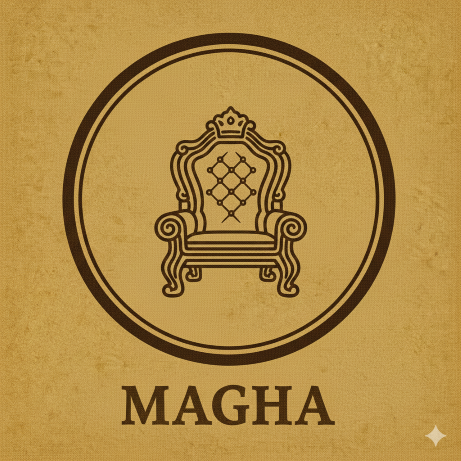
3. Symbol and Its Psychological Meaning — Throne / Royal Seat
The throne represents position, not action.
Psychologically, it signifies stability of command, entitlement through lineage or merit, and responsibility of leadership. Magha’s power is static but absolute.
Influence comes to the throne; the throne does not chase influence.
4. Ruling Deity — Pitrs
The Pitrs represent ancestral authority and inherited wisdom. Magha governs tradition, lineage and continuity of values.
Under Magha, the Pitrs operate as obligation to ancestors, respect for tradition and duty to preserve what was handed down. Magha does not invent power. It inherits and maintains it.
5. Planetary Ruler — Ketu
Ketu ruling Magha is critical. Ketu gives detachment from personal desire, authority without hunger and power without obsession.
Magha does not seek validation. It exists beyond approval. Ketu ensures Magha’s authority is impersonal — rooted in role, not ego.
6. How Magha Expresses When Strong
A mature Magha produces natural authority and command without coercion. It gives:
- Leadership without insecurity
- Respect for structure and tradition
- Dignified presence
Such individuals occupy leadership roles effortlessly, uphold institutions and protect legacy and values. They are often heads of families, organizations, or systems — not because they demand power, but because others expect it of them.
7. How Magha Distorts When Unconscious
When awareness is missing, Magha becomes arrogant, rigidly hierarchical and entitled. Common distortions include:
- Confusing status with worth
- Demanding respect without responsibility
- Living off past glory
- Resisting necessary change
This is authority without respect.
8. Relationship with the Moon
Moon in Magha creates a mind that feels emotionally safe through status, identifies strongly with role or title and feels threatened by loss of respect. Emotionally, dignity is survival.
Such individuals react strongly to disrespect, carry ancestral pride and struggle when authority is questioned. Loss of respect feels threatening, and authority is taken personally.
9. Evolutionary Lesson of Magha
Magha must learn that authority must be renewed through responsibility.
The lesson is to honor tradition without stagnation, to lead without entitlement and to serve the role, not become imprisoned by it. Magha matures when it learns: “I sit on the throne to serve order, not myself.”
10. Summary
Magha is the seat of power. It governs authority, lineage, and rightful command. When unconscious, it becomes arrogant and rigid. When mature, it becomes dignified leadership that preserves order and legacy.