Swati Nakshatra: Meaning, Nature, and Evolutionary Role
1. What a Nakshatra Really Is
A nakshatra is not a personality trait but a deep psychological conditioning field. While planets show what is acting and zodiac signs show how it expresses, nakshatras reveal why reactions arise instinctively and emotionally. They operate below conscious thought, shaping reflexes, attachment patterns, and inner responses before choice or reasoning appears. This is why nakshatras feel personal — they show how experience is processed at the deepest level of the mind.
This nakshatra shows how identity seeks freedom after form is achieved.
If Hasta executes and Chitra designs and defines, Swati detaches and moves. Life now asks, “Can I exist without being held?”
Form no longer wants containment. Swati represents motion after acknowledging identity.
2. Core Nature of Swati (Essence)
Swati’s core drive is to remain free, flexible, and self-directed.
It represents the instinct: “I must not be bound.”
Swati does not resist structure aggressively. It simply refuses confinement. This nakshatra values independence, choice, adaptability and personal autonomy. Swati wants space — physical, mental, and emotional.
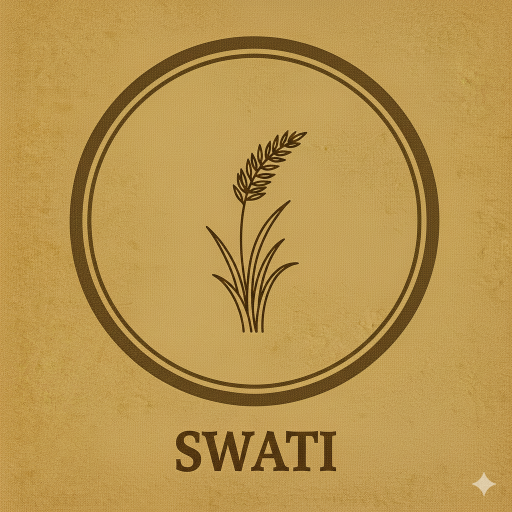
3. Symbol and Its Psychological Meaning — Young Plant in the Wind
The young plant bends but does not break, moving with the wind rather than opposing it.
Psychologically, this symbolizes flexibility, survival through adjustment, and strength through non-resistance. Swati survives not by holding ground, but by knowing when to move.
4. Ruling Deity — Vayu
Vayu is the principle of movement and breath. He governs circulation, expansion and life-force motion.
Under Swati, Vayu operates as desire for freedom, need for open spaces and intolerance of stagnation. Swati cannot thrive where energy does not move.
5. Planetary Ruler — Rahu
Rahu ruling Swati intensifies the desire for autonomy, breaking from norms and unconventional paths.
Swati does not want freedom for peace. It wants freedom for self-definition. Rahu intensifies the need to explore without permission.
6. How Swati Expresses When Strong
A mature Swati produces:
- Independence without rebellion
- Adaptability without instability
- Confidence in self-direction
- Capacity to survive anywhere
Such individuals thrive in changing environments, navigate cultures, ideas, and systems easily and remain self-defined without isolation. They often excel as traders, travelers, consultants, entrepreneurs, or thinkers — roles requiring movement and autonomy.
7. How Swati Distorts When Unconscious
Without awareness, Swati becomes unrooted and avoidant. Common distortions include:
- Fear of commitment
- Inwardly anxious
- Directionless independence
- Fear of dependence
Such individuals constantly move without purpose, escape intimacy in the name of freedom and confuse avoidance with independence. This is freedom without center.
8. Relationship with the Moon
Moon in Swati creates a mind that feels emotionally safe with options, becomes uneasy when restricted regulates emotion through distance. Emotionally, closeness can feel suffocating.
Such individuals need space to process feelings, withdraw rather than confront and calm down when autonomy is restored. Restriction increases anxiety, while autonomy restores balance.
9. Evolutionary Lesson of Swati
Swati must learn that freedom requires inner anchoring.
The lesson is to choose movement consciously, to commit without feeling trapped and to develop roots without losing wings. Swati matures when it learns: “I can be free and still belong.”
10. Summary
Swati is the wind of independence. It adapts, moves, and refuses confinement. When unconscious, it becomes evasive. When mature, it becomes flexible freedom grounded by inner stability.