Degrees in Astrology: Why Placement Is Not Binary?
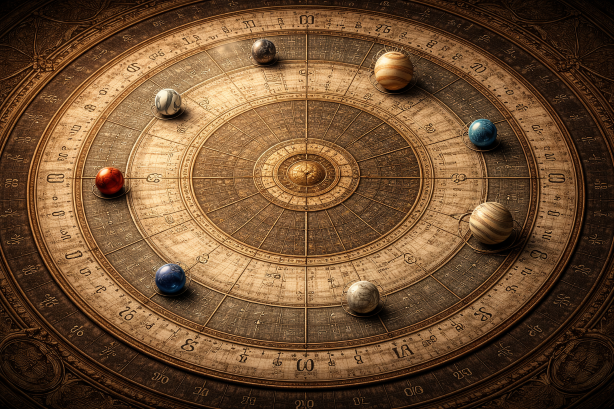
Most people read astrology as if placement is binary: a planet is either “in a sign” or “not in a sign,” a yoga either “exists” or “does not exist.”
Degrees exist precisely to break this false binary.
They explain how deeply a planet has entered a field of experience, how mature its expression is, and how integrated it is with the rest of the chart. Without degrees, astrology remains symbolic. With degrees, it becomes structural.
1. What Does a Degree Actually Represent in Astrology?
A degree represents the state of engagement a planet within an environment.
A sign defines the type of environment. A degree tells you how far that planet has entered, adapted to, or exhausted that environment.
Degrees are not coordinates alone. They are phases of integration. A planet at 2° and the same planet at 28° are not doing the same thing, even though they are in the same sign. One is learning the rules. The other has internalized—or overextended—them.
Example
Consider Mars in Capricorn:
- 2° Capricorn — Mars has just entered discipline. Action is still impulsive but constrained. Frustration arises because rules feel external.
- 15° Capricorn — Mars has internalized structure. Effort becomes disciplined and strategic.
- 28° Capricorn — Mars embodies discipline. Action becomes authority. This is why Mars is exalted here.
Same planet. Same sign. Entirely different functional states.
2. Why Are Signs Divided into 30 Degrees at All?
Because experience unfolds gradually, not instantaneously.
If planetary expression changed instantly at sign boundaries, astrology would imply discontinuous psychology and behavior. Signs are divided into degrees to represent progression through an environment: entry, consolidation, and saturation.
Example
Take Mercury in Virgo:
- Early Virgo — over-analysis and insecurity about correctness.
- Mid Virgo — precise, efficient discrimination.
- Late Virgo — hyper-critical thinking and mental fatigue.
3. Why Is Planetary Expression Different at Early, Middle, and Late Degrees?
Because planets behave differently when they are initiating, stabilizing, or completing a mode of operation. Degree is therefore not intensity alone. It is developmental phase.
- Early degrees (0–10) — Exploration, raw expression, lack of refinement.
- Middle degrees (10–20) — balance, stability, optimal functioning
- Late degrees (20–30) — mastery, excess, or exhaustion
Mars early Capricorn still acts impulsively; discipline is external, not internalized.
Moon early Taurus is still learning stability; security is sought, not assumed.
Mercury mid-Virgo shows discrimination with flexibility.
Saturn mid-Libra balances restraint with fairness.
Mars late Capricorn has learned restraint so fully that action becomes strategic power.
Mercury late Pisces may dissolve analysis entirely, replacing it with symbolism or intuition.
4. Why Do Some Planets Exalt at Early Degrees While Others Exalt at Late Degrees?
Because different planets require different stages of an environment to function optimally.
Some planets need purity and simplicity. Others need maturity and containment. Exaltation occurs where the environment provides exactly what the planet needs to express its highest function.
Examples
- Moon exalted at ~3° Taurus — The Moon needs immediate stability and sensory grounding. Early Taurus offers freshness without stagnation. Security is alive, not inert.
- Mars exalted at ~28° Capricorn — Mars needs restraint to refine aggression into authority. Only a fully matured Capricorn environment provides discipline that Mars no longer resists.
5. What Does It Mean When a Planet Is Very Close to the Ascendant Degree?
The Ascendant is where consciousness meets the world. A planet close to it becomes unavoidable in lived experience. Degree proximity to the Ascendant often matters more than house classification.
Examples
- Saturn within 2° of Ascendant — Life feels serious, effortful, responsibility-heavy from early life—even if Saturn is technically in the 12th house.
- Venus within 3° of Ascendant — Relationships, aesthetics, and social harmony dominate identity expression, regardless of sign.
6. Why Do Conjunctions Depend on Degree Proximity, Not Sign Placement?
A conjunction requires shared phase, not just shared space. Two planets must be close in degree and in compatible developmental stages to truly integrate.
Examples
- Sun 5° Leo + Mercury 27° Leo — Both in Leo, but one is initiating identity while the other is concluding expression. Integration is weak.
- Sun 14° Leo + Mercury 16° Leo — Same phase, same environment. Identity and expression reinforce each other.
7. Why Do Some Yogas Fail Even When Planets Are in the Same Sign?
Yogas require functional overlap and compatible phases. When planets are too far apart in degrees or in different phases, the yoga exists conceptually but does not activate experientially.
Example
- Jupiter 2° Cancer + Moon 28° Cancer — One is initiating emotional expansion; the other is emotionally saturated. The expected yoga underperforms.
Degrees determine whether planets are actually working together—or merely occupying the same territory.
8. How Do Degrees Explain Why the Same Placement Gives Different Results?
Sign-based labels collapse multiple states i.e. phase, proximity, and maturity into one category. Degrees reintroduce specificity. Example: Mars in Capricorn
- 4° Capricorn — discipline learned through frustration
- 12° Capricorn — controlled ambition
- 28° Capricorn — strategic authority
Same sign. Same planet. Different functional states. Degrees explain why identical sign placements do not produce identical lives.
9. What Happens When Planets Are Too Close to the Sun?
When a planet is too close to the Sun, it loses independent autonomy, not existence. Its function is absorbed into identity. This is commonly called combustion, but its effect varies by planet.
- Mercury combust — Thinking becomes identity-bound. Intelligence is strong internally but hard to externalize.
- Venus combust — Desire merges with ego. Relationships become central to self-definition.
- Mars combust — Action becomes ego-reactive. Assertion lacks strategic distance.
Combustion redirects function through the Sun; it does not destroy it.
10. How Should Degrees Be Read Without Turning Astrology Into Numerology?
Degrees are qualitative phases, not lucky or unlucky numbers. They describe readiness, maturity, proximity, and integration. They do not predict events, guarantee success and impose fate.
29° is not bad; it is saturated. Whether that saturation produces mastery or exhaustion depends on context.
Integration
Degrees complete astrology’s logic.
- Signs describe environment.
- Planets describe function.
- Degrees describe state of engagement.
They explain why exaltation peaks where it does, why proximity matters more than labels, why yogas are conditional why astrology cannot be binary.
Without degrees, astrology is symbolic. With degrees, astrology becomes dynamic, developmental, and real.