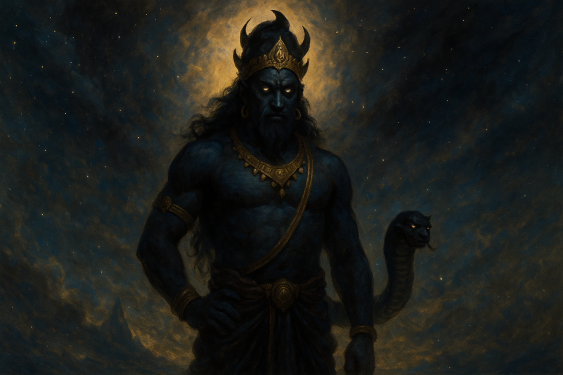
Ketu: Meaning, Role, and Importance in Astrology

1. What a Planet Really Is — Placing Ketu Correctly
In Jyotisha, a planet is not an event-maker. A planet is a principle of consciousness that operates through signs and houses.
- Signs show how a principle behaves
- Houses show where it acts
- Planets show what is acting
Ketu is not loss. Ketu represents severance with awareness.
If Rahu pulls consciousness into experience, Ketu pulls consciousness out of identification.
Ketu does not remove the world. It removes the illusion of necessity around the world. Without Ketu, experience never completes, and without completion, wisdom never forms.
2. Core Identity of Ketu — What Ketu Symbolizes
Ketu represents:
- Detachment and separation
- Disinterest and withdrawal
- Insight born of exhaustion
- Past-life mastery
- Spiritual discrimination
- Dissolution of ego attachments
- Liberation tendencies
Psychologically, Ketu answers the question: “Why am I still holding this?”
A strong Ketu brings clarity, Non-attachment without bitterness, Ability to let go without fear and Penetrating insight. A distorted Ketu produces escapism, apathy, Nihilism and Disconnection from life without understanding.
Example: Two people lose the same thing. One feels free while the other falls into sadness.
3. Ketu vs Rahu — The Axis of Completion
Ketu and Rahu always operate as an axis.
- Rahu — hunger, accumulation, experience
- Ketu — exhaustion, release, completion
Rahu asks, “What more can I get?”
Ketu asks, “Why does this no longer matter?”
Rahu builds identity through desire. Ketu dismantles identity through understanding.
This is not opposition, but sequence: experience first, understanding later.
4. Signs Ruled by Ketu — Functional Nature
Classically, Ketu does not rule a sign in the conventional sense. Functionally, Ketu operates strongly in signs that encourage depth, withdrawal, and transcendence.
Ketu does not amplify like Rahu. It cuts and disconnects.
Ketu has no agenda. It only responds when something has been over-experienced. Where Rahu exaggerates, Ketu nullifies. Where Rahu obsesses, Ketu becomes disinterested.
5. How Ketu Operates Through Different Zodiac Signs
Ketu always removes attachment. The zodiac sign determines what loses meaning.
"So when we say “Ketu in a sign”, we are really saying:"
Ketu in Fire Signs (Aries, Leo, Sagittarius)
Detachment from ego, authority, and belief systems. It gives loss of interest in dominance or leadership.
Example: A fire Ketu individual withdraws from ambition and recognition.
Contrast with Rahu: Rahu obsesses over power and validation.
Ketu in Earth Signs (Taurus, Virgo, Capricorn)
Detachment from material security and control. Makes a person disinterested in accumulation, tendencies become minimalistic.
Example: An earth Ketu individual simplifies life and rejects accumulation.
Contrast with Rahu: Rahu clings to material success.
Ketu in Air Signs (Gemini, Libra, Aquarius)
Detachment from ideas, opinions, and social validation. Silence replaces argument, interest in networking vanishes.
Example: An air Ketu individual disengages from intellectual competition.
Contrast with Rahu: Rahu seeks influence and visibility.
Ketu in Water Signs (Cancer, Scorpio, Pisces)
Detachment from emotional dependency and attachment.
Example: A water Ketu individual seeks solitude and inner depth.
Contrast with Rahu: Rahu craves emotional fusion.
6. What It Means When Ketu Is Strong
A strong Ketu does not imply renunciation. It implies clarity after experience.
- Deep insight
- Inner silence
- Freedom from compulsive desire
- Spiritual discrimination
A strong Ketu person walks away from what others still chase. They see through illusions quickly, are not easily impressed and are able to detach without hatred.
7. What It Means When Ketu Is Weak or Distorted
A weak or distorted Ketu removes engagement without producing understanding. Common signs are:
- Escapism
- Apathy
- Depression
- Spiritual bypassing
Example: A person rejects the world without having understood it.
Ketu matures through awareness, not avoidance.
8. Integrating Ketu with Sign and House
Ketu must always be judged with:
- Sign — area of detachment
- House — domain losing meaning
- Dispositor — ability to ground insight
- Aspects — support or fragmentation
Examples:
Ketu in the 12th house promotes natural withdrawal.
Ketu in the 10th house reduces attachment to status.
Ketu with Saturn disciplines detachment.
Ketu with Moon creates emotional emptiness or clarity.
9. Why Ketu Matters
Ketu without grounding disconnects. Ketu with awareness liberates. When Ketu is ignored or misunderstood:
- Life becomes repetitive
- Desire never resolves
- Wisdom never crystallizes
- Detachment turns bitter
Ketu teaches one essential truth: Nothing releases you except understanding.
Ketu exist because Rahu exists. Without Rahu, there would be nothing for Ketu to cut away, nothing fully lived, nothing understood. Rahu pulls the soul into desire so experience can ripen; Ketu releases the soul once that experience has been exhausted. They stand on opposite ends of the same axis because growth requires both engagement and release — without Rahu life would not begin, and without Ketu it would never end.